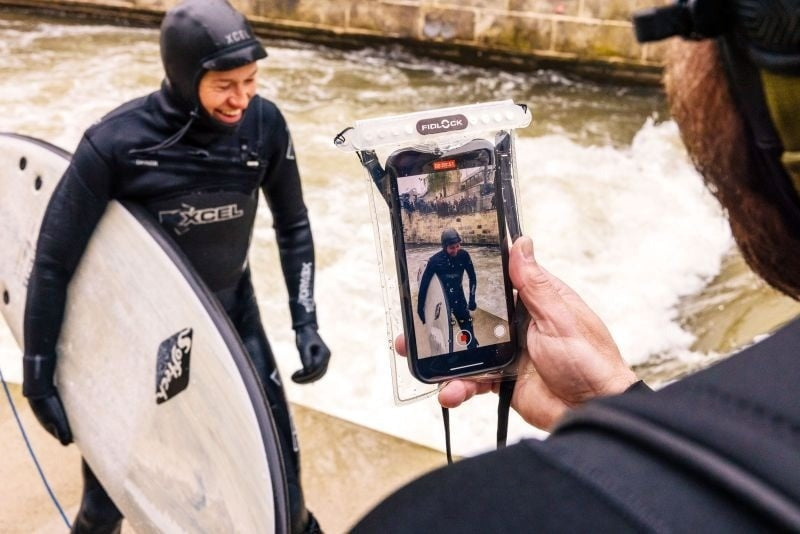
The first duck dive of the day tells you everything. If water immediately starts running up your back, you'll be more focused on warming up than on your next wave. Choosing a wetsuit for surfing is therefore not just about a nice logo or the highest price. It's about enough warmth, full freedom of movement, and a suit that fits so well you forget you're wearing it.
Along the Dutch coast, wind, water temperature, and sun sometimes change faster than the sets. So don't blindly choose the suit your friend wears or the thinnest model that feels nice and flexible in the store. Consider when you go into the water, how quickly you get cold, and how long your sessions usually last. That will lead you to a wetsuit you can really rely on.
Choosing a wetsuit for surfing starts with the temperature
Neoprene thickness is indicated in millimeters, often with two or three digits. In a 4/3 mm, the torso is 4 mm thick for warmth, while the arms and legs are 3 mm thick for more freedom of movement. Generally, the thicker the neoprene, the warmer the suit. But thicker isn't automatically better: a suit that's too thick can make your paddling stroke harder and quickly feel restrictive in the soft autumn sun.
For the Dutch surf coast, a 4/3 mm wetsuit is the most versatile choice for many surfers. In spring, summer, and early autumn, you can often comfortably get into the water in it. Are you really sensitive to the cold, do you surf for a long time, or do you also go for a session in winter? Then a 5/4 mm suit, preferably with a hood, is a logical step.
A 3/2 mm wetsuit is great for warm summer days, a surf trip to a milder climate, or for surfers who warm up quickly. Just don't expect it to get you through a blustery Dutch autumn day. The perceived temperature in the water is determined by more than the thermometer. Wind, rain, long waits outside the lineup, and a low body temperature after a few wipeouts all count.
A practical guideline for Scheveningen and the rest of the Netherlands
Roughly from May through September, a 3/2 mm suit can work well on warm days, although many surfers also appreciate a 4/3 mm for longer sessions. In spring and autumn, 4/3 mm is usually the safe all-round choice. In winter, cold hands, feet, and wind call for 5/4 mm neoprene, plus accessories. It remains personal: a dedicated surfer who moves a lot may feel warmer in the same conditions than a beginner who spends more time waiting on their board.
The fit is more important than the price tag
The best neoprene retains little warmth if cold water keeps flushing through your suit. A wetsuit must fit tightly without restricting your breathing or locking your shoulders. You'll feel some resistance when putting it on—that's part of it. After a few minutes, the neoprene will conform better to your body.
Pay extra attention to the lower back, armpits, shoulders, knees, and neck. No large hollow space should form at your lower back. Water collects there and cools down every time. The neck must fit without chafing or pinching. A neck that's too wide creates the familiar cold flush with every duck dive, while a neck that's too tight makes your session uncomfortable before you even reach the lineup.
The length also matters. The legs must reach your ankles and the sleeves your wrists. A suit that's too short will pull on your shoulders when you paddle. Legs or sleeves that are too long can bunch up and trap water. Therefore, don't try on a wetsuit standing up alone. Make paddling motions, squat as if you're standing on your board, and twist your torso. That's when you'll notice whether you can move freely.
Don't get stuck between two sizes
Are you between two sizes? Don't automatically choose the larger one just because it feels more comfortable in the fitting room. Neoprene gives a little in the water. A suit that feels loose around your waist when dry will often be too roomy when wet. At the same time, a wetsuit that numbs your arms or puts pressure on your chest is not a good investment. Different brands cut differently: one model is made for long arms, another for broader shoulders. Fit always beats the size on the label.
Flexible neoprene or maximum warmth?
Wetsuits differ not only in thickness. The type of neoprene, the panels, and the lining determine how a suit feels. Flexible neoprene in the shoulders makes paddling and pop-ups easier. That's great if you surf a lot, go on long sessions, or are still working on your technique. Warmer thermal linings on the chest and back keep your core comfortable longer, especially when you're waiting quietly in the lineup.
There is a trade-off, though. A super-flexible suit is often more vulnerable than a stiffer, heavier model. Those who often sit with their knees on the sand, surf a lot, or use their suit intensively will benefit from reinforced knees and well-finished seams. Good maintenance then extends the lifespan more than you think: rinse your suit after every session with fresh, cold water, let it dry inside out away from direct sunlight, and don't hang it for long periods from the shoulders of a thin hanger.
Zip, seams, and entry: small details, big difference
The position of the zip determines how easily you can put on a suit and how much water can get in. A back zip has a zipper on the back. This type is often easy to put on and take off, which is convenient for beginners and for anyone who wants to get out of their suit quickly after a cold session. However, the zip can let a little more water in than a well-sealed chest zip.
A chest zip opens at the chest and usually seals better against water. This makes it a popular choice for those who often surf in colder water. Putting it on sometimes requires a bit more technique, especially the first few times. A zipless wetsuit offers a lot of flexibility and lets in very little water, but it's not the easiest entry for everyone. Choose what suits your use, not just what sounds the most technical.
Also pay attention to the seams. Flatlock seams are comfortable and breathe well, but let more water through and are best suited for warmer conditions. Glued and blind-stitched seams keep water out better. Taped seams add extra protection. For a Dutch all-round suit, good, watertight seams are often not a luxury, but exactly the difference between another set of wipeouts and shivering your way back to shore.
Don't forget boots, gloves, and a hood
In cold water, your body loses a lot of heat through your hands, feet, and head. You can wear the warmest suit in the world, but with numb toes, surfing quickly becomes less fun and less safe. Neoprene boots are indispensable in autumn and winter for many surfers. Choose a sole that provides enough grip on wet sand and a fit that's tight enough not to twist on your board.
Surf gloves come in different thicknesses. Thin gloves give more feel when paddling, while thicker models retain warmth longer. For really cold days, mittens are often warmer than gloves, although you lose some mobility. A hood keeps the wind off your head and prevents your body from losing unnecessary heat. It may look less summery, but a winter glassy morning feels a lot better when you stay warm.
Buy for your real surf days
Ask yourself an honest question: when do you actually go surfing? Someone who only takes a few lessons in July needs something different from someone who checks every northwesterly swell as soon as it builds. Beginners spend more time lying and sitting in the water, which causes them to cool down faster. For them, a slightly warmer suit is often smarter than an ultrathin, competition-oriented model.
If you surf all year round, a combination of two suits can be ideal: a 4/3 mm as a reliable all-rounder and a 5/4 mm for winter and blustery days. If you have the budget for one suit, it's better to choose a quality 4/3 mm that fits well than multiple compromises. A wetsuit you enjoy putting on will get you more hours in the water. And more hours in the water ultimately lead to the best surf progression.
If you're torn between models, take the time to try them on and honestly tell us how, where, and when you surf. Our surfers at Hart Beach know the cold of the North Sea and would rather help you choose a suit for many good sessions than a quick choice. Check out the waves, put on something that fits, and stay out a little longer when the sets finally come in.