





Which fins do I need?
Fins determine almost 50% of how your surfboard performs in the water. Yet, choosing the right fins remains a mystery for many surfers. In this updated guide, we explain step by step how to find the perfect match – from fin system to configuration, from flex to foil.
The Function of Fins: Stability, Lift & Drag
Fins serve two crucial functions. Firstly, they provide stability: without fins, your board would drift sideways off the wave without control. The fin acts as a pivot point from which you initiate turns. Secondly, side fins generate lift: thanks to a streamlined foil shape—similar to an airplane wing—they create pressure towards the wave face, giving you more speed and drive.
It's important to know that every fin has the 1st function, but not always the 2nd.
An important side effect is drag: every fin in the water slows down the board. More fins and larger fins = more grip, but also more resistance. The art is to find the right balance for your surfing style and the waves you ride.
Question 1: Which Fin System do you have?
Over the years, many different fin systems have come and gone. Currently, there are two companies that make excellent systems that allow you to easily install your fins in your board: FCS and Futures. They also have older and newer systems, so here is an overview of the most common ones:FCS IFCS I (also called "twin tab") is the old FCS system and can be recognized by the 2 identical rectangular sections that go into the board. These are secured with 2 small hex screws.Shop FCS IFCS IIFCS II is the newest FCS system and is also called "click tab". It is one of the most convenient systems for traveling and changing your fins, as you can click the fins into the board without screws.Shop FCS IIYou can mount FCS I fins into an FCS II system using a filler kit, but you cannot mount FCS II into FCS I.FuturesFutures is the main competitor of FCS and is also called "single tab." This is simply because the part that goes into the board on Futures fins is a single, elongated insert.Shop FuturesUS BoxThe majority of all single fins have a US Box in the tail. This is a fin box that is longer than the fin itself, allowing you to move the fin forward or backward as desired. You attach the fin on one side with metal pins in the box and then use a screw to secure it to a metal plate.Shop US Box
Question 2: What kind of Fin Setup (configuration) is on your board?
There are many different types of boards, and many of these boards come with a predetermined fin configuration. Sometimes you can also choose what you want to put on your board. Therefore, it is good to know what the different setups are and what they do.The following 5 fin configurations are the most common:Single Fin | Twin Fin | Thruster (Tri Fin) | Quad fin | 5-finSingle FinA Single fin provides function 1: stability. This configuration is often found on boards with a long rail (e.g., longboards). These boards already have a lot of grip due to their long rail, so they need less of function 2. The single fin also provides a good pivot point. Because long rails are difficult to turn, you can use the pivot point at the tail to turn your board.Click here for beautiful single fin longboards. There are also beautiful mid-length boards with a single fin.Twin FinTwin fins have two fairly large fins on the side of the board, and both are foiled. The foil of the fins creates lateral pressure and gives you extra grip on the rails. Therefore, Twin fins are often found on boards with a short rail line or boards that are very round and have little effective rail in the water (to provide the board with extra grip). Because there is no fin in the middle of the board (and therefore no resistance), water can easily flow under the board, which generates speed. However, you miss the control of the middle fin.Inspiration for this came from Paipo fins (classic Hawaiian bodyboards). Bob Simmons used them in the 50s, but eventually, partly due to Mark Richards (who won 2 world titles on them in the 70s), twin fins grew into a phenomenon.Shop Twin Fins2+1A traditional 2+1 setup means that in addition to a single fin, you have 2 small side fins that give you extra hold and control. This allows you to change the feel of your single fin or place a smaller fin in your middle box.Nowadays, there are also fin setups where 2+1 means you have a small trailer (middle) fin with a twin fin set. This gives you a nice blend of a twin fin with a Thruster setup.Click here for great 2+1 options.Thruster (Tri-Fin)The Thruster is considered "the best of both worlds." Stability and the pivot of the center fin, but also the grip of a twin fin. The side fins on a Thruster are smaller than on a twin-fin because the middle fin provides extra stability and control.The thruster became popular through Simon Anderson, who was looking for a solution for his build and powerful surfing in small waves on the world tour. He met a local in Narrabeen, who used a small center fin as a stabilizer. The concept appealed to him, and he made his own version with 3 identical fins. When he then showed what was possible with it on the world stage, he won everyone over.The Thruster is currently the most commonly surfed fin configuration and therefore has the most extensive range.Shop ThrustersQuad FinThe Quad fin configuration works similarly to the Twin fin, but there are 2 fins instead of 1 at each rail. Therefore, Quads also work very well on a board with a short rail line or boards that are very round and have little effective rail in the water.Quads also work well in powerful waves and situations where speed (because you don't have a center fin) and rail grip are desired.Quads have more control and a better pivot point than twin fins because there is space between the fins on each rail, and water glides through it.Shop Quad Fins5 FinThe 5 Fin setup is common nowadays due to the flexibility it offers. If there are 5 fin options under your board, you have the option to surf the board as a Quad (by using the outer 4 fin boxes) or as a Thruster (by using the middle and the 2 outer ones). There are also boards that are surfed with 5 fins, such as some Bonzers.Shop 5-fins
Question 3: What fin size do I need?
So now you know the type of fin system on your board and what kind of fin configuration you are looking for. Now let's move on to a more sensitive topic...What is your weight?Be honest here; it won't end up on Tinder. The following table is a general guideline, and we encourage everyone to try different sizes to find out what works best for them. You can click on the size name to view the options. Size Weight LBS Weight KGGrom XS75 - 115lbs35 - 52kgSmall105lb - 155lb47 - 70kgMedium145 - 180lbs(with Futures 145-195lbs)65 - 80kg(with Futures 65-88kg)Large165lbs+(with Futures 180lbs+)75kg+(with Futures 80kg+)* This does not apply to single fins; for those sizes, go to the 'Single Fins' section in question 4
Question 4: What type of fin do I need?
Now we've arrived at a more technical section, delving deeper into the wild west of fin geometry. You can go as crazy as you like here, but luckily, all the major players in the fin system world have simplified it for you, for example, by categorizing their fins into "families." Futures uses a "ride number" to simplify it for you.However, many brands that make fins for the FCS and Futures systems don't do that. Therefore, it might be a good idea to dive in and learn more about all the elements that go into a fin.If you don't want to do this and just want to know which fin from the two biggest brands suits you best? Then go to the section onFCSorFutures.
Fin sizes and geometry
In addition to different configurations, fins come in many different shapes and sizes. To inform and assist you, we would like to introduce you to the various elements taken into account with a fin: the Sweep (Rake), Toe, Base Length, Foil, Flex, Height, and Cant.
Sweep
The Sweep or Rake of a fin refers to how far the tip of the fin bends backward relative to the fin's base. This is measured in degrees from the base to the tip of the fin.Fins where the tip bends far back (and thus has a small rake) give you drive, stability, and help with larger turns.Fins where the tip bends less far back (and has a larger rake) allow you to make shorter turns. This can help you, for example, in smaller, fast waves to quickly maneuver your board in tight spaces.
Toe/Splay
The way your fins are positioned under your board is determined by the person who makes the board. They are not all parallel to each other. The center fin is almost always straight in the middle of the board. The side fins are often at an angle relative to the center of the board. The angle at which they are positioned relative to the center is called the "toe" or "splay." If your side fins are angled, more pressure is applied to the outside of the fins, which provides more responsiveness.
Base (Length)
The base of the fin is the bottom part of the fin. It is the part that sits against the board, and its length helps you with turning. Fins with a longer base will give you more speed and allow you to make longer turns. If you prefer to make shorter turns, you should opt for a fin with a shorter base.
Foil
The Foil of a fin refers to the shape of the inner and outer surfaces of the fin. For example, a fin is somewhat thicker at the front and in the middle, and very thin towards the back. The fin's foil affects how water flows under your board and, consequently, how your fins and board respond. There are 4 different types that are most commonly used: 50/50, flat foil, inside foil, and 80/20.
While almost every center fin has a 50/50 foil, this is different for the side fins, so here's a brief explanation of each foil:50/50This foil means that the fin is symmetrical and convex on both sides. It is almost always found on the center fin and on single fins. It ensures even water flow and stability.Flat FoilFins with a flat foil have a convex outer surface (the side facing the rail of your board) and a flat inner surface. This is always found on side fins and provides a good balance between drive and hold.Inside FoilIf a fin has an 'inside foil', it has a convex outer surface like a flat foil, but also a curve (or concave) on the inside. This curve ensures efficient water flow and provides even more lift and hold while maintaining speed.80/20The 80/20 foil is mainly found on Quad rear fins. These are (like the 50/50 foil) convex on both sides, but the curvature on the outside of the fin (80% towards the rail) is greater than the curvature on the inside (20% on the inside).
Flex
The 'Flex' of a fin is the way the fin bends sideways. This flexibility is determined by how and from what the fin is constructed. A flexible fin bends further and yields more. You can generate speed more easily with it, but they react less precisely. They are often used in less powerful and friendlier waves. A stiffer fin bends less and yields less. This makes it react very well. These fins are often used in fast and hollow waves.Nowadays, fins are made of all kinds of materials, and they can create very specific "flex patterns" on a fin. For example, a fin can be stiff at the base (giving you a lot of hold) and flexible at the top (allowing your tail to break loose a bit more easily in a turn to slide).
Height/Depth
The height and/or depth of a fin refers to the fin's height. This is measured from the base to the highest point of the fin. So, how many centimeters or inches of fin you have in the water.The larger the fin, the more hold you have in turns. But because you have larger fins, you also have to turn larger fins, and it can become more difficult. Incidentally, larger fins can also help you generate more speed if the waves are not powerful enough, because you have more fin surface to push against.With a smaller fin, you have less hold, and you can make your board slide more easily.
Cant
The "cant" is the way the fin is angled sideways relative to the surfboard. It is measured in degrees of an angle. A fin that is upright has a cant of 90 degrees and is nice and fast, but more difficult to turn. A fin with a large cant (so more than 90 degrees) is easier to turn but slower.
The FCS Fin Family
FCS has categorized its fins into 4 families: Reactor, Performer, Accelerator, and Carver.Each of these families has its own characteristics that are ideal for a particular surfing style and type of waves. They are neatly described in the image below.Within these families, there are multiple models with their own characteristics. For example, the technology differs per model, making it stiffer or more flexible, which will make the fin react differently. The overview shows the different technologies and their influence on the flexibility and responsiveness of your fin.To give an example, we use the normal Performer fin set in Neo Glass.It is therefore a balanced fin with good flow and response for many different conditions (the Performer Family). It also has a fair amount of flex and therefore a delayed response (Neo Glass).If you were to take the same fin (the normal Performer fin set) in Performance Core Carbon (PCC), then you still have a balanced fin design for many different conditions. The difference then lies in the PCC technology, which makes your fin react faster and have less flex.An overview of which fins fall under which family can be found below, and all the options we have can be found here.
Futures
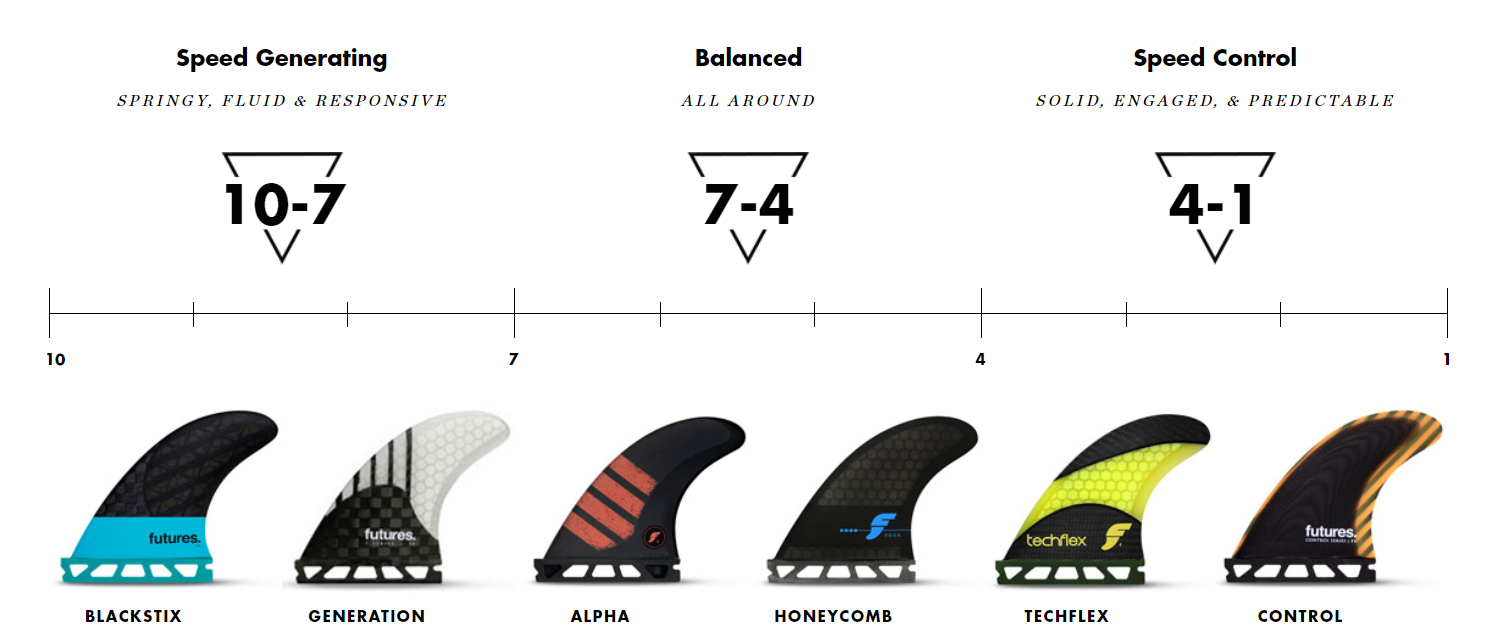
Futures naturally has its own system and uses a Ride Number to indicate how the fin will react and what it is intended for.
On the scale below, you can see that the ride number tells you (on a scale of 10 to 1) whether the fins are intended to generate speed (Speed Generating/10) or control speed (Speed Control/1).
Fins on the Speed Generating side are more resilient, making it easy to generate speed when the waves lack power. On the other hand, you have fins that react more precisely and give you extra hold when the waves are already providing that speed.
Their rule of thumb is: “If you are pumping - Speed Generating, If the waves are pumping - Speed Control.”
The ride number is constructed by a combination of flex, rake, and foil, with flex and rake being the most significant factors. View all the fins we have and their ride numbers here.
Extra Tips
- You never know for sure, so don't be lazy! Try different fin setups in your board. If you have the option to put different configurations in your board, it can give your board a whole new feel.
- Loose boards will have better drive if they have a stiffer, larger fin with more sweep. Stiffer boards, on the other hand, can be made more playful by putting a more flexible fin in them with less sweep.
- Surfboards with wide tails often require a larger fin.
Fin Systems: FCS II, Futures, and more
FCS II is the most widely used system as of 2026. Its click-tab technology means you can change fins without tools — perfect for surfers who like to experiment or travel. FCS II is backward compatible: with an adapter, FCS I fins will also fit.
Futures uses a single, elongated tab and is known for its stiffness and strength. Many shapers and professional surfers swear by the direct energy transfer of the Futures system. For power surfers, this is the go-to choice.
FCS I (twin-tab) is the older FCS system with two screws. Still present on many boards, but most new boards come with FCS II or Futures.
US Box is the standard for single fins, typically on longboards. The fin can be placed forward or backward in the box, allowing you to fine-tune your board's trim characteristics.
Fin Configurations: From Single to Quad and 5-Fin
Single fin: Pure flow and classic feel. Ideal for longboards and single-fin retro shapes. Provides a smooth, gliding ride with little pivot and a lot of drive straight down the line.
Twin fin: Two fins for maximum speed and a loose, playful feel. The twin fin setup is back in 2026, popular on modern fish and retro shapes.
Thruster (Tri fin): The most common setup in the world. Three fins provide an excellent balance of speed, drive, and maneuverability. The standard for shortboards and high-performance surfing.
Quad fin: Four fins, no center fin. This gives enormous speed and lift — perfect in hollow, barreling waves. The quad feels looser than a thruster but faster through the section.
5-fin: Five fin boxes in your board offer ultimate flexibility. Surf as a thruster, quad, or twin — depending on the day and the waves.
Fin Characteristics: Rake, Flex, Foil, Base & Height
Rake (sweep): The angle of the fin towards the back. More rake = larger turning radius, fluid, wide turns. Less rake = more pivot, fast, tight turns.
Flex: More flexible fins provide a springy, energetic feel when exiting turns. Stiffer fins offer more direct drive and control in powerful waves.
Foil: The shape of the fin's cross-section. Flat foil (outside) and streamlined (inside) provides lift. Inside foil on all surfaces gives more drive in a straight line.
Base: The width at the base of the fin determines the drive. Wider base = more drive and stability.
Height: The height of the fin determines the grip. Taller fin = more hold, even in steep waves.
Not sure which fins are best for you? Visit Hart Beach Surfshop — our team will help you find the perfect set based on your board, weight, and surf style.

Join the Crew
Follow us and receive the latest event updates and product launches on our gram
@hartbeachsurf

Customer service
It's not really free, we've just priced it into the products.

Fast Free Shipping
Get free shipping on orders of €150 or more

14-Day Return Policy
You can always return products you have purchased

Secure payment
Your payment information is processed securely.